At one of our workshops, a girl dropped a folded piece of paper into the anonymous question box. On it, in careful handwriting, were four words: what even is a period?
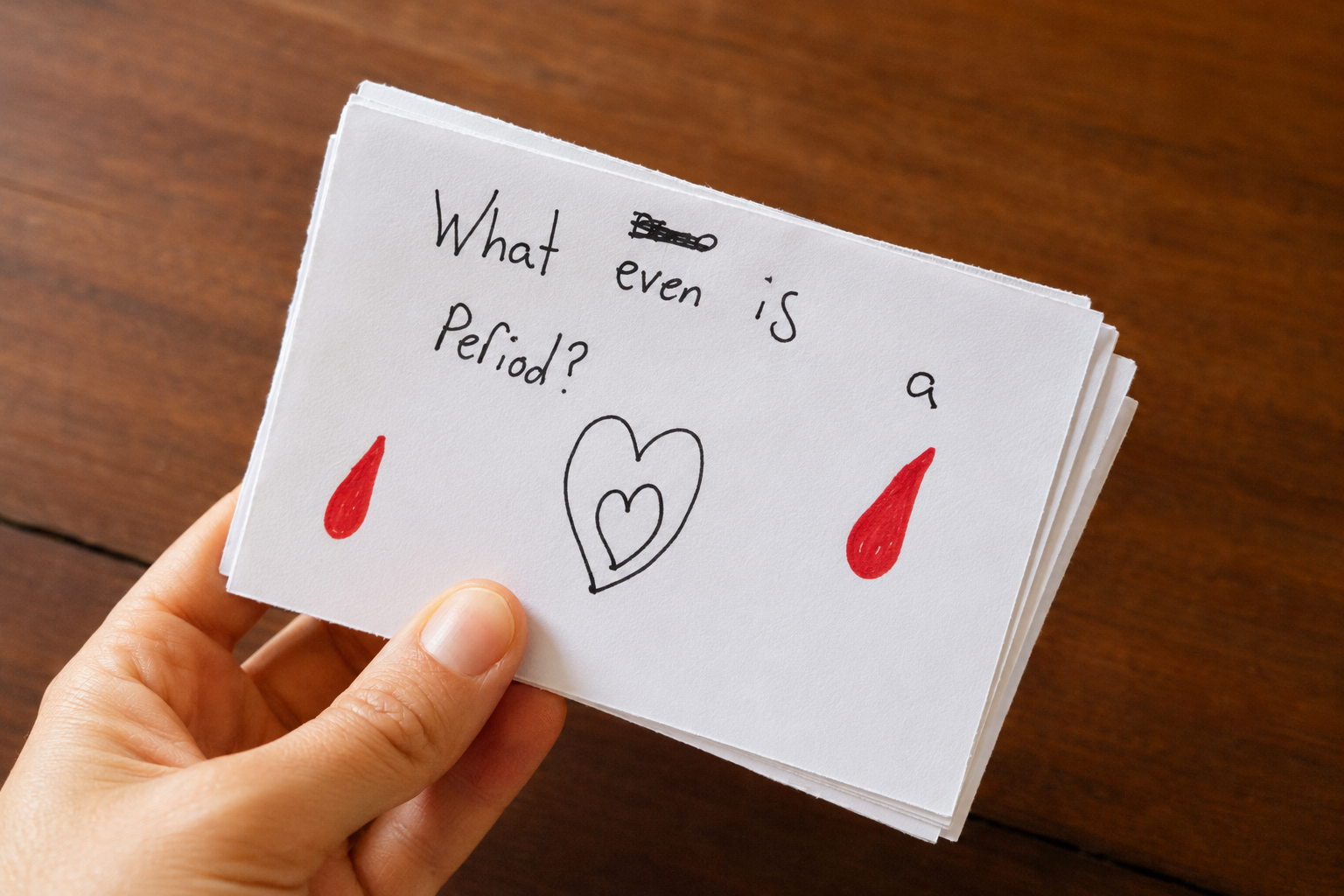
It's one of the most common questions we get, and it's a good one. Better than it looks. Because most of us who have had periods for years have never actually stopped to answer it. We know the routine. We know where the products are. But the why of it, why there's blood, why it happens at all, often went unexplained for us too.
So before you explain it to your child, it helps to have the clear answer for yourself. Not the rushed version. The real one.
The clear answer, for parents
Here's the part that tends to get skipped, and it's the part children most want to understand: a period isn't the body going wrong. It's the body doing something quietly extraordinary.
Think of it like making a bed. Once a month, the uterus makes up a soft, thick lining, like laying down a fresh, cosy doona, ready in case a baby ever needs to grow there. Most months, there's no baby. So the body simply strips the bed, clears away that lining, and starts making it up again. That clearing-away is the period: the lining leaving the body through the vagina, over about three to seven days.
That's the whole logic of it. The bleeding isn't an injury or a loss. It's the reset at the end of a monthly cycle that's been running quietly the whole time.
A few things worth being solid on, so nothing catches you or your child off guard:
There's an average, but a wide range around it. In Australia, the average age for a first period is around 12 to 13, though it can arrive any time between nine and fifteen. Earlier or later can be perfectly normal too. There's no "right" time, and bodies don't read the calendar.
The early years are irregular. When periods first begin, cycles can be all over the place, closer together, further apart, skipping a month. In the early years, cycles can run anywhere from 21 to 45 days, usually settling into a more regular pattern about two years after the first period. Irregular early on is expected, not a problem.
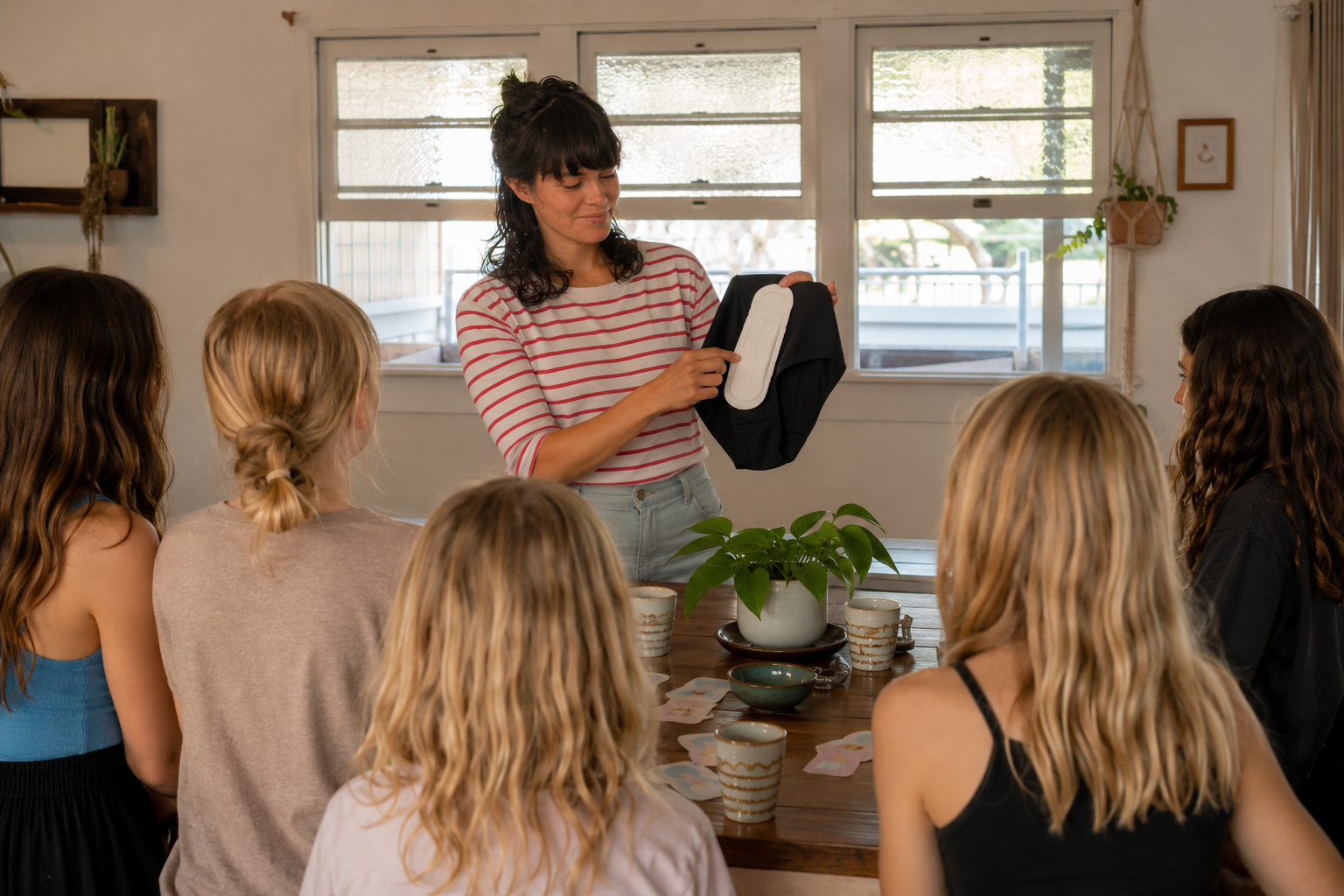
It doesn't look like the ads. Real menstrual blood isn't the tidy blue liquid in the commercials. It's usually bright red at first and darkens to brown towards the end, heaviest in the first day or two, and there's less of it than most people expect: a few tablespoons across the whole period, not a flood. This is exactly why, in our workshops, we bring out real period products and use fake red blood to show how they actually work. Seeing it makes it real, and far less mysterious. You can read more about that in The Period Products That Made the Adults Say, "Wait, What?"
Saying it to your child
Here's how you might put it into words. Treat the ages below as a rough guide, not a rule. You know your child's curiosity and readiness far better than any age band does. Some children want the whole picture at eight; others would rather a short answer at twelve. Follow the child in front of you.
For a younger child (around 6 to 9), keep it simple and matter-of-fact:
"A period is something that happens to bodies that have a uterus."
"About once a month, the body gets ready in case it might grow a baby one day."
"When there's no baby, it clears everything out, and a little blood comes out through the vagina for a few days."
"It's not sore or scary. It's just something bodies do."
For an older child (around 10 to 12), you can say more, and invite the questions underneath:
"Your body's been getting ready for this for a while."
"Each month the uterus builds up a soft lining, like making up a bed in case a baby ever grows there. When there isn't one, the body lets that lining go (that's the blood) and starts fresh."
"It usually lasts a few days, and the first ones can be irregular. That's completely normal."
"Is there anything about it you're wondering about, or anything that feels a bit worrying?"
The principle underneath both: answer the question they actually asked, don't rush to say everything at once, and let them know they can always come back with more.
Explaining it to boys
Periods aren't only a conversation for children who'll have them.
Every person alive grew inside a uterus, and the monthly cycle that periods are part of is exactly what makes that possible. In a real sense, periods are part of why any of us are here. That's worth a boy knowing.
There are everyday reasons too. Boys will have friends who menstruate, may one day have a partner who does, and will grow up to work alongside colleagues who do. Roughly half the population menstruates. Understanding what's going on, calmly, without mystery or squeamishness, is simply part of being a considerate person in the world.
So explain it to boys with the same warmth and the same facts. No wrinkled nose, no "you don't need to know about that." A period is a normal, healthy thing. It isn't disgusting, it isn't embarrassing, and it isn't a secret. A boy who understands that grows up more comfortable, more respectful, and easier for the people around him to be honest with.
The bit that matters more than the mechanics
You can explain the biology perfectly and still leave the most important thing unsaid.
Because a child doesn't only absorb the facts about periods. They absorb how you feel about them. Whether your voice drops to a whisper. Whether the products are hidden at the back of a cupboard. Whether "that time of the month" is said with a sigh. Children read all of it, and it teaches them whether their changing body is something to meet with confidence or with quiet shame.
None of this needs a big performance. A few small, ordinary things tend to do more than any single talk, offered as ideas, not instructions. Take the ones that feel right for your family:
Name it naturally. If you're on your period and feeling tired, you might just say so: "I've got my period today, so I'm a bit low on energy. I might have a quiet afternoon." Nothing dramatic. It simply signals this is a normal thing people talk about.
Let the products be visible, and freely available. For families comfortable with it, keeping pads or tampons somewhere in view, rather than tucked away, quietly says these are ordinary things, not something to hide. It also means anyone who needs one can simply take one, which is its own small act of support and normalising.
These won't suit every household, and that's completely fine. The point isn't to perform openness. It's that the calmer and more matter-of-fact periods are at home, the easier they'll be for your child to meet when their turn comes.
And if you don't get it perfect
You won't cover everything. You'll fumble a word, or get asked something you have to look up. And when you are asked something you can't answer, that's not a problem, it's an opportunity: "That's a great question. Let's find out together" teaches them that curiosity is welcome and that not knowing is fine.
That's not a failure. That's a conversation.
Your child doesn't need the flawless explanation. They need to know the question was welcome, and that they can come back with the next one.
Answer what they asked. Keep it warm. Leave the door open.
Trustworthy places to read more
If you'd like to go deeper, or want something to look at alongside your child, these Australian resources are clear, reliable and free:
Raising Children Network, Periods (raisingchildren.net.au)
The Royal Children's Hospital, Kids Health Info: Periods (rch.org.au)
The Royal Women's Hospital, Periods (thewomens.org.au)
Jean Hailes, Periods (jeanhailes.org.au)
healthdirect, Menstruation (healthdirect.gov.au)
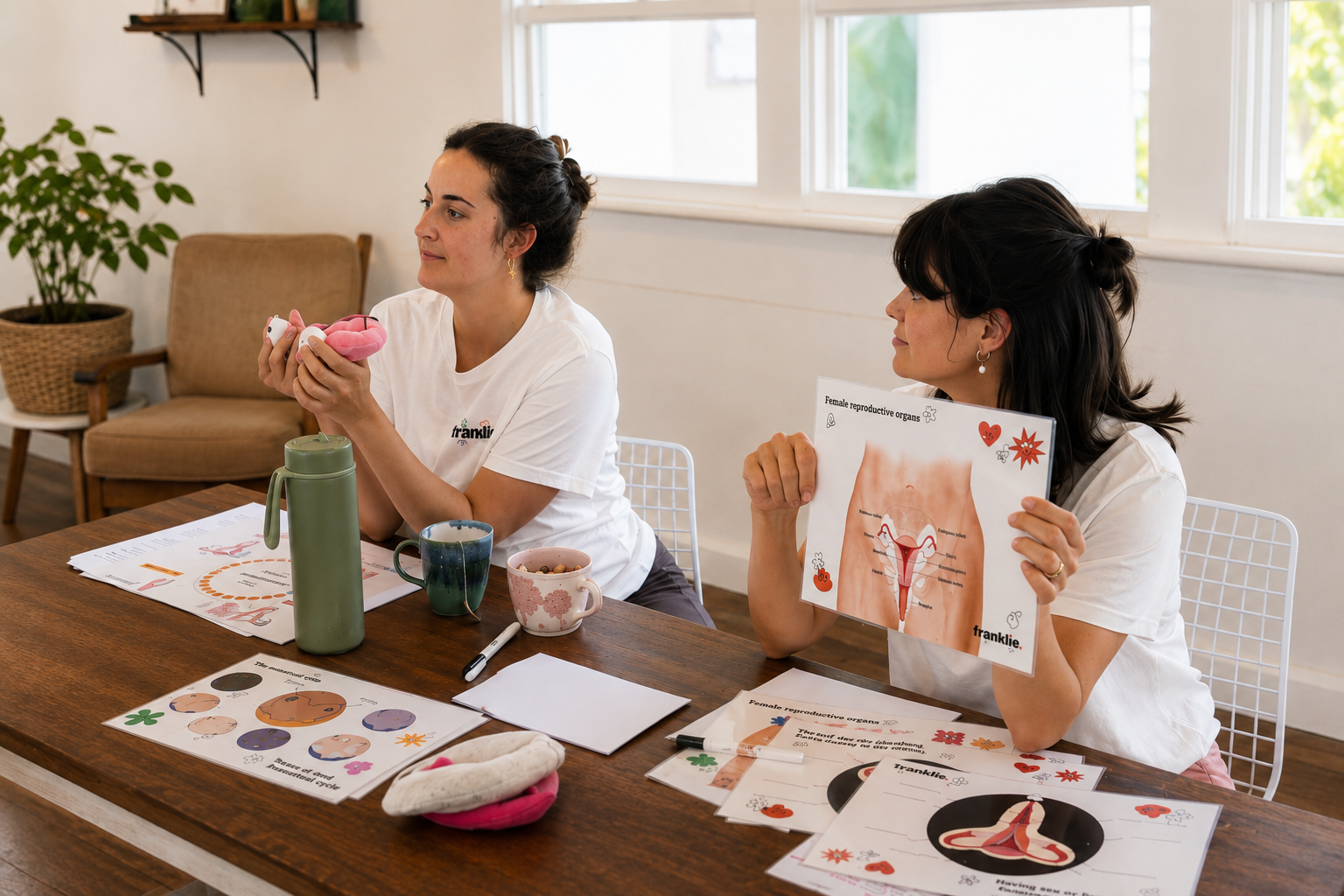
Want to make periods feel ordinary, together? Our Period & Puberty workshops give children clear, calm answers and hands-on time with real products, and give you the shared language to keep the conversation going at home.
Find our next Period & Puberty event.
A gentle note: this is general information, not medical advice. If anything about your child's periods worries you, it's always worth a chat with your GP.